 info@abravenew.com
 (206) 746-5024
 2400 NW 80th St, #540, Seattle, WA 98117


.png)
Chris Prudhomme is a digital marketing leader with 10+ years of growth, brand, and performance experience. He is currently Head of Marketing at Zivian Health, a B2B healthcare SaaS company that provides compliance infrastructure for organizations deploying advanced practice provider (NP & PA) workforces.
Chris began his career on the agency side as a copywriter and has grown into a hands-on marketing leader with range across content, SEO, paid media, and creative strategy, working in industries from social innovation to hospitality. His focus has increasingly centered on healthcare and workforce management: before Zivian, he led digital marketing at Gifted Healthcare, a national clinical staffing company, where he built the demand engine that drew thousands of clinician applicants a year. Chris now applies a blend of his creative roots and performance rigor to one of healthcare's most complex, trust-driven categories.
What you’ll learn about in this episode:
- How Zivian Health uses brand to make complex regulatory and compliance challenges feel simpler, clearer, and more manageable.
- Why trust is one of the most important differentiators for healthtech brands and how branding helps earn it before the sales conversation begins.
- How to simplify complex healthtech value propositions by focusing on the human emotions behind the problem, not just the technical features.
- How memorable healthtech brands can be distinctive without sacrificing credibility, professionalism, or trust.
- How Zivian Health is positioning itself around the shift in how healthcare organizations build and manage their clinical workforce.
- Why brand building and performance marketing should work together, and how a strong brand can make performance marketing efforts work harder.
- How niche healthtech companies can prioritize the right marketing channels when their total addressable market is highly specialized.
- What healthcare brands need to consider as AI becomes more embedded in healthcare—and why clinical oversight and trust will be critical to responsible adoption.
Additional resources:
- Chris Prudhomme on LinkedIn
- Zivian Health’s website
- Josh Dougherty on LinkedIn
- Josh Dougherty’s speaking site
- A Brave New’s website
Transcript
Josh Dougherty:
Welcome to A Brave New Podcast. This is a show about branding and marketing in the healthcare space. But more than that, it's an exploration of what it takes to create brands that will be remembered and how marketing can be a catalyst for those brands' success. I'm Josh Dougherty, your host. Let's dive in.
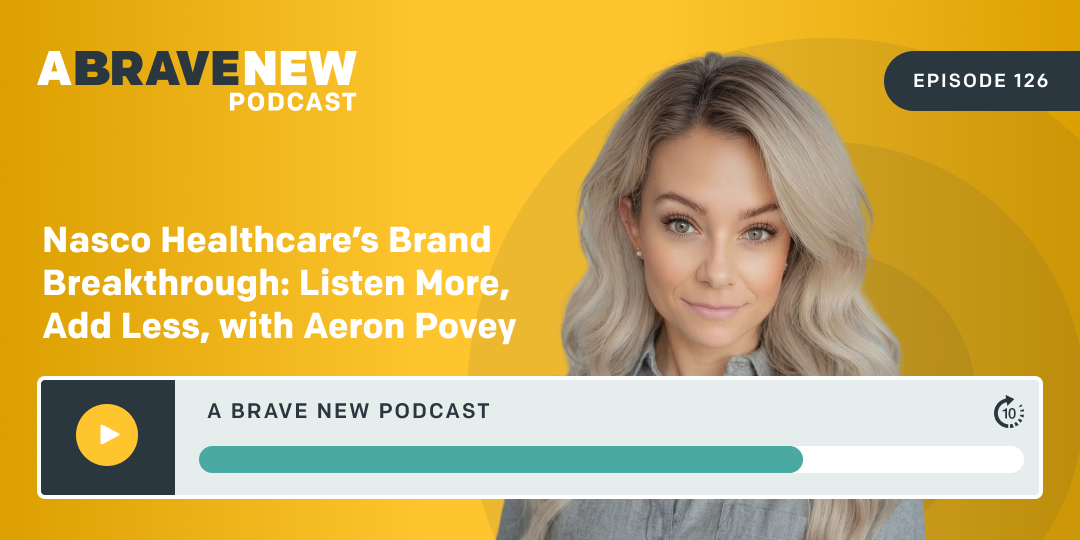
Welcome back to the show. It's great to have you on and with me again. Today, I'm going to talk to Chris Prudhomme. Chris is the head of marketing at Zivian Health, and Zivian Health is a compliance company that helps organizations that need providers across states and handles the credentialing and the compliance needs for getting advanced practice provider workforces into the field, so that you think about physician assistants, nurse practitioners, et cetera.
Chris is a veteran of multiple years working in the healthcare space, doing both growth marketing, demand gen. He also has a background as a copywriter, which I love selfishly because that's my background as well. I think all his experience combined from both working demand and growth, working as a copywriter, and thinking deeply about brand has led him to have some really thoughtful approaches.
And I think you'll appreciate this conversation. We're going to spend some time discussing not only the philosophy of brand and how do you build connection in the health tech space, and how do you build trust, ultimately, but also we will be speaking about their recent brand repositioning that they've done as well as some approaches and what's working well for them on the performance side and how performance and brand overlap and overlay and work together to drive success. So it's going to be a great convo, and I'd love to welcome Chris into the show. Hey Chris, welcome to the show. Thanks for coming on.
Chris Prudhomme:
Great to be here. Thank you for having me, Josh.
Josh Dougherty:
Awesome. Well, I know we have a lot to talk about today, but I would love to start with you having a little bit of a chance to tell your story. Could you share some of the relevant parts of your professional journey that led you to your current role at Zivian Health?
Chris Prudhomme:
Yeah, sure. So I guess to start way back in school, I was an avid writer, studied English, loved writing, wanted to be some kind of a writer. I think that's where I started. And then eventually ended up in marketing because I think it afforded me an opportunity to do a lot of writing. And I started as a copywriter in the creative agency space working across a lot of different clients, really had a lot of growth marketing principles and fundamentals in that workspace and that really interested me.
So I think I grew along that path over time. Also worked in the nonprofit social innovation industry, worked for a former business incubator that helped local businesses get off the ground and grow, but eventually found myself in the healthcare space and really enjoyed it. It felt like the most sense of meaning and ultimate purpose that I had had as a marketer when I ended up there, mostly in back office workforce management healthcare category, clinical staffing. And then I found myself at Zivian Health, which is really B2B software compliance.
Josh Dougherty:
Yeah. Awesome. Can you share a little bit about what Zivian Health is all about and what your focus is as a brand? I know we'll get into it more of the nuts and bolts, but what is the basic elevator pitch?
Chris Prudhomme:
Sure. So Zivian Health is a software company that helps healthcare organizations, growth stage, digital health, hybrid organizations, a wide range. Anyone who has really an advanced practice provider workforce, so nurse practitioners and physician assistants, we help them deploy across states. We help them manage and execute compliance across those providers, and we also have what we call a marketplace.
It's not a traditional marketplace, it's a compliance marketplace. But these types of providers, many of them across states, need to have what is called a collaborating physician in order to practice legally. And so we have a network of thousands of credentialed physicians where we make those connections and help NPs and PAs get to the bedside and practice.
Josh Dougherty:
Yeah. Awesome. Cool. Thanks for that. I think that's the type of work … I think back … My wife used to work in administration for radiology and if your solution had existed when she was doing that, because she worked on credentialing for advanced practitioners to get them going, she would've loved to have the benefit—a decade too late, right?
Chris Prudhomme:
Yeah. No, I know. It's a ton of work. It's a lot of work. Yeah.
Josh Dougherty:
Yeah. Well, we're going to dive into a lot of what the work you've been doing from a positioning perspective and how you're driving growth with Zivian, but I would love to start out just by asking you how you personally define branding when you think of that term. What comes to mind? How do you think about it?
Chris Prudhomme:
A good question. It's one of those open-ended questions that can be hard to answer sometimes, but I definitely stole this from somewhere and I think it might've been Scott Galloway. I see brand as a combination of promise and performance, kind of simple, but a promise being everything you signal before someone has used your product or service and then following through on that promise. That's the simple basic components of a good brand to me.
Josh Dougherty:
Yeah. And I think first off, it means you're a good marketer that you can't remember where you grabbed it from because I think we all are sharing and stealing things from each other.
Chris Prudhomme:
Yeah, it's in my swipe folder somewhere.
Josh Dougherty:
Exactly. Everybody's got a good swipe folder, but I think that's really true. We always talk about brand being such an intangible thing that you're just trying to influence, and it is through that consistent performance that fulfills on a unique promise over time. So I resonate with that definition. It's good.
Why do you think that investing in that type of work, defining out that promise, defining out how you deliver on the promise and performance is important in health tech? I think sometimes it can be forgotten and we become and are very laser focused on product only in this space. But I'm a contrarian that says I think if you're going to focus on brand, you're going to stand out in this space. So I think from your work, you would say the same thing, but why do you think it's important?
Chris Prudhomme:
No, I would definitely agree with that. And I guess I can relate this back to some of my recent work at Zivian. We just did a rather large rebrand late last year in 2025. I think it's important to invest in brand and health tech because every category runs on trust. Trust is a ubiquitous thing, but in healthcare, I think the stakes are higher.
You're touching people's health, their healthcare data, their compliance risk, their license—if you're dealing with providers. And so in healthcare and health tech, if there is no trust or if there is even a question of trust, there's really no business in many ways I think. And so brand and positioning I think are a way that you earn that trust before the sales conversation happens.
And then the performance piece that we just talked about is how you maintain that trust. But I also think that while we were doing this rebrand, we did a lot of research, looked at the competitive marketplace we were in but also a little bit broader. And it's true, I think that that high value that is placed on trust within healthcare actually starts to … they move that caution straight into the brand in any way, where it's like, "We got to play it safe. We want smiling physicians and clinicians on our website and we're innovative."
These kinds of things. And there's nothing wrong with that, but that's kind of the conversations we were having when we were rebranding. And I think you can be trustworthy and distinctive at the same time, but I think, ultimately, things within healthcare end up looking the same because you don't want to ... I kind of relate it to a doctor's waiting room. You don't want your doctor to have wacky wallpaper, you don't want it to feel unsettling, you want it to feel calm and considered like somebody thought about your experience, and that ends up, I think in some ways, making things ultimately look the same.
Josh Dougherty:
I agree with you. I think at some point it's kind of like the Hippocratic oath, it's do no harm with your brand so that people will trust you. That's the thing I always think about.
Chris Prudhomme:
And rightly so in healthcare, healthcare shouldn't necessarily be one of these kind of move-fast-and-break-things industries, but I think there's a balance that you can maintain.
Josh Dougherty:
I think it's also thinking maybe differently about positioning because we think about flashy consumer brands that are positioned really well. You think about someone like Liquid Death, the water, great brand, but that's never going to fit in this industry. But I do think you can be trustworthy and be distinctive without being flashy if you think about the emotional connections you want to build with your brand, right?
Chris Prudhomme:
100%.
Josh Dougherty:
It's just a little bit of a deeper level of. I don't think it's a deeper level. It's a different expression of branding, right?
Chris Prudhomme:
Yes. Yes. Agreed.
Josh Dougherty:
So I talk a lot about how branding is about memory, and how we're trying to instill a memory with folks. And one of the things that I wanted to pick your brain on—having gone through this process and looking at different brands recently—was, in your opinion, what do you think is maybe the most important element to building a memorable brand in health tech right now? It's also pressure to say, what's the most important element? You can give me a couple things if you can't zero in on one.
Chris Prudhomme:
Yeah. Again, I think maybe keep it simple here for us and for me. I think that, especially nowadays, and maybe this extends beyond health tech, with AI tools, the idea of more, more, more is I think very prevalent. And I think in order to create and instill a memory within a brand, because you really have a few seconds for someone who's brand new, is to stand for one thing very clearly and say that one thing very clearly and cut everything else away.
So in some sense, this definition that I'm outlining is just contrast, and I'll relate it back to our branding project. We did a color spectrum analysis of one of our competitors and some companies that we really liked, and we found that almost all of them sat within this very distinct category of the color spectrum. And one of the major ways that we distinguished ourselves is breaking out of that. And that is more of an ambient kind of intangible thing, I think, when people engage with the brand, with the website, but I think it really makes a difference.
Josh Dougherty:
Yeah, it's a real thing, right? Because if you look different than everybody else, at least it maybe buys you four more seconds to give another message to people.
Chris Prudhomme:
Exactly. And those are the kinds of increments we have to fight for, I think.
Josh Dougherty:
Yeah. My background is that I started as a direct response copywriter, so wanting to really capture attention just like you were in the copywriting space. And so speaking like we're talking like copywriters, former copywriters, here. It's like, what's the hook that I'm going to get you in on? But it's true.
Chris Prudhomme:
Yes. And I think that still lives in my brain as one of the go-tos for me of how I see marketing maybe in general. So yeah, definitely influenced by that experience.
Josh Dougherty:
Yeah. It's a good experience to influence. I'm biased, but of course. Well, speaking of cutting things away and simplifying, you guys operate in a really complex regulatory space, right? There are a lot of regulations to follow. People are coming to you because it's complicated to deploy these advanced practice providers. How have you approached simplifying your complex value proposition for this audience that's pretty focused and pretty niche?
Chris Prudhomme:
Yeah, I think it's really about doing the reps. When Zivian started, I was an early member of the organization, and so we had some groundwork that was laid in terms of the product market fit, these things, but we were very new. And so it's a matter. I think simplifying something complex is just a repetitive practice and it continues to this day.
I'll be doing it today when we're done with this call. And I think the regulatory maze around workforce deployment, it's super complicated and it has been for decades. But back to I think something you said about emotional resonance, the feeling that people get when they engage with this landscape is not unique and it's not complicated. People hate waiting on things. They hate drowning in the minutia of whatever admin work they're doing.
And in terms of our business, they hate the feeling of being exposed, that they're doing something wrong, that it's going to catch up with them, that there's information out there that they have a hard time finding. And I think that's the level you have to get to whenever you're creating a value proposition that's going to resonate within that super small-time window that we were talking about. The features are how we solve that problem, but I think before you start listing features and benefits of the product, you have to hit the base level emotion that that's why anyone cares. That's kind of how I feel about it.
Josh Dougherty:
Yeah. And I do think it is the reps. It's the testing, it's going through and seeing like, "Okay, we tried this message for a while. This really resonated. We need to adjust it, tweak it slightly to be able to sharpen it." That sort of thing.
Chris Prudhomme:
Right. And I think there's a pipeline that's involved there where it's not, as a marketer, I think you don't live in this vacuum. In some ways, I think as a marketer, you have a really interesting vantage point within the business in general. I think if you are super engaged, you should really know what's going on in operations, you should really know what's going on in sales.
And in order to do that work at the very top of the funnel, you have to be communicating with those other teams to understand, okay, we acquired a customer, we maybe got them to implementation based on this messaging, but did we really misrepresent the expectations that we should have been giving? So there's always refining to be done there.
Josh Dougherty:
Yeah, I think about that too a lot. I often tell people marketing can even be a catalyst for change in product and change in how things work internally because you have that real team time feedback able to bring back big ideas to the organization that they may not see otherwise.
Chris Prudhomme:
100%.
Josh Dougherty:
I'd love to hear about how the physician shortage has influenced your ability to grow and scale. This is a real thing that we've been facing for at least half a decade in the United States as not enough doctors are coming into the system. So how is-
Chris Prudhomme:
Yeah. Yes. On this topic, I feel like I could speak for too long because it's really central to how we position Zivian and how we run the front end of the business. The advanced practice provider workforce to get into some data, MPs and PAs, they're projected to grow around 40% over the next decade as faster, faster than any other workforce in the country. And that's partially driven by physicians that are aging out and a population that's getting older and needs more care.
And our position as a company is the physician-to-APP ratio used to be roughly four to one within clinical settings. Within 20 years, it's heading toward a one-to-one ratio. So APPs go from this kind of supplement to care to becoming super central to how care in this country is deployed. And so we feel that deploying and managing this workforce is becoming not a niche back-office chore anymore. It's going to become fundamental to health and healthcare organizations’ growth.
Josh Dougherty:
I was going to say-
Chris Prudhomme:
Sorry, go ahead.
Josh Dougherty:
... it is the thing that people have to do if they want to continue to serve their patients well at the end of the day.
Chris Prudhomme:
Yes. I've spoken about it. It's almost like a law of nature. Right now within growing healthcare organizations, many of them employ this, they have an NP and PA integrated workforce. If they want to scale their business, they're going to probably employ more of them and they're going to run into these kinds of regulatory challenges that we try to solve. So that is fundamentally integrated into the way that we look at how we're speaking to our ideal customer.
Josh Dougherty:
Mm-hmm. Yeah. Awesome. As you're thinking about that ideal customer, can you share a little bit more about that core concept or essence of the brand that you're trying to communicate? Obviously, I know maybe you don't want to share exactly what that is, but can you talk about it a little bit?
Chris Prudhomme:
Yeah, no, absolutely. I mean, there's definitely no super secret sauce. I think we're a compliance company. I think, really, simplicity is at the core of our brand or when we were doing this overhaul, something that I pushed on very hard, which I guess that sounds simple in essence, but when we think of our ideal customer, they live inside this wall of data, state rules, credentials, deadlines, filings, very exhausting. And when they engage with our brand, we want them to feel like they can breathe.
So I'll give you an example. We have five shades of off-white in our brand color palette, and that's very intentional where negative space was something that we really wanted someone to feel an openness, and we want a sense of relief that, "Hey, we can solve these problems." We don't want it to feel like you are looking at a compliance dashboard right now with a bunch of provider data. Our platform does those things, but the brand itself is meant to communicate the other end of that journey.
Josh Dougherty:
Yeah, I think I get that. When I land on your website, it just has a little bit of, "Oh, you're not trying to cram all the things down my ... I'm not trying to consume everything all at once." And so it gives me a chance to sit back while you're also obviously being very focused on the messages you need to communicate.
Chris Prudhomme:
I hope that's the feeling that's communicating.
Josh Dougherty:
Yeah. It's the intent at least.
Chris Prudhomme:
Yeah.
Josh Dougherty:
Well, tell me a little bit about that balance. You do have a platform, it does very technical work. How do you balance that technical feature selling and the human storytelling inside of the marketing that you're doing?
Chris Prudhomme:
Yeah, this is something that, again, we're working on and talking about every day because, we talked about this before, I think feature selling is maybe the instinct because it's the easiest to write. You know the product, you know what benefits it should provide the user, but I think it comes back to emotional resonance. So I think healthcare doesn't have, at least back office and workforce management, things that are not bedside-related healthcare and don't necessarily have the human interest stories that maybe hospitality or entertainment has, but healthcare is full of extraordinary people doing amazing work.
They're healing people, they're affecting and saving lives, and you can always, I think, find the thread back to that. So in the case of Zivian, to use my current role as an example, we are not at the bedside, but we are one or two steps removed from helping a provider get to the bedside and helping an organization grow, do a launch into a new market, serve more patients. And so we're right on top of that pain that grinds at our customer every day, and I think you can always find that thread.
So finding the emotional resonance and then finding a way to tell that healthcare story is something that we talk a lot about, and I think that has to come first in many ways, even if it's just in spirit. We are a software company, so you won't see a whole lot of, to give an easy example, like those smiling doctor pictures on that website. But I think you will find a spirit of hopefully humanity, intention, and helpfulness.
Josh Dougherty:
Yeah. And I don't think it would be appropriate for you to have all those images of smiling doctors because people are coming to you for a software product. They just want it to feel human and connected at the same time, right?
Chris Prudhomme:
Yeah, absolutely.
Josh Dougherty:
Yeah. So I'd love to transition. I know you have a lot of background in growth and demand gen, so I would like to transition the conversation there a little bit. I think there's an inherent balance as you're growing and scaling a brand. You guys have a big market opportunity. Could you chat with me a little bit about how you're balancing brand building with performance marketing and how they compliment or maybe even butt up against each other sometimes in your work?
Chris Prudhomme:
Certainly. I definitely see it as a complement. So I think what can be difficult sometimes is getting very concrete and practical and data-driven about how your brand is performing per se on the front end. But I think that brand, like I had mentioned, creates the demand and it makes every performance dollar work harder. So it's kind of like two different time horizons.
The performance marketing aspect of a marketer's role is quick acquisition, and the brand is in some ways a halo effect that makes all of those dollars and all of that time and execution and rigor compound, both at the top of the funnel and later on as things play out in retention and that dollar retention and all of those kinds of things. So brand's accountable for making the performance aspect cheaper in many ways.
Josh Dougherty:
It's like a multiplier of impact almost.
Chris Prudhomme:
Yeah, exactly. It's a multiplier of impact. And I don't think that if you are solely focused on the data components of your performance marketing program, looking at cost of acquisition, even up to smaller metrics like conversion rate, cost per click, all of these things, if you have a solid brand foundation, you will see those things positively impacted on the performance marketing side. And to me, that's how they're related and complement one another.
Josh Dougherty:
Yeah, excellent. Where are you seeing success in performance marketing right now? What are the things that are working well for you?
Chris Prudhomme:
Yeah. Well, Google Search and both paid and organic are kind of our bread and butter, and I think that is related to the restraints we have in terms of it's a niche audience. We see it as a fundamental audience within healthcare, but it's a very niche need. And ultimately, you have to be practical about this and you have to test things early on, and whenever you find a channel that works, lean in. And that's what happened for us with Google. And I think it's really because … let's take a specific use case.
Nurse practitioners, they need a collaboration agreement. That is a really specific term. Most people who are searching that term are not doing it for any other reason besides they're interested in a product or service that helps them in that way. And so it's a matter of a lot of testing and getting very in the weeds around what our customers are looking for and the very practical components of the compliance process.
Josh Dougherty:
Totally.
Chris Prudhomme:
We were able to zero in on that and scale that type of campaign and continue to do so.
Josh Dougherty:
Yeah. So I'm interested, I like to dig into this a little bit because I am a big believer in search being a core component, but we're seeing a lot of flux in how search is happening and Google is leaning into zero-click marketing is a big thing now, all the AI results. So how are you evolving and managing that flux as it being one of your core channels that you're emphasizing?
Chris Prudhomme:
Yeah, that's a really good question. It's an ongoing thing. My answer may be very different if you ask me three or four months from now.
Josh Dougherty:
Totally, totally.
Chris Prudhomme:
But right now, I think that when it comes to AEO, GEO, the idea of good fundamentals of traditional search still apply, and it's a matter of really reaching your target audience at each stage of the funnel just like you would with traditional search, but some slight modifications to how you're creating and formatting and structuring the content and depth of content. And maybe you've seen some of the research about what types of content is more likely to be pulled into these AI search engines.
It's a matter of staying on top of that, making sure your content portfolio is rich enough so that you're hitting all of those categories. And again, thankfully, I think we're fortunate in this way that we still live in a niche market, so it's not like we're having to contend with a huge additional outside range of competitors. It's still the same set of folks that we're contending with and the same set of information. It's just really a matter of staying on top of what's working and making sure that your content portfolio is hitting those targets. I know that's kind of a vague answer, but yeah.
Josh Dougherty:
I mean, what else can we say if we're having, I think even over the last months of spam updates and stuff by Google, there's just the constant change as it tries to, I think, learn how to deal with onslaught of AI content and how it's impacted everything.
Chris Prudhomme:
Yeah. And I guess one other thing I might say is I think usefulness is still very important and you can churn out content all day long, but in terms of converting folks rather than just driving traffic, understanding their core need and making sure your content is useful is still going to win, in my opinion.
Josh Dougherty:
And that's been true forever, right?
Chris Prudhomme:
Yes. Yes.
Josh Dougherty:
Are you giving someone something they need when they actually land on your website or however they get to know you? So we've talked about how to focus your content portfolio. I'd love to hear a little bit about how your team handles content production that's both educational and engaging. What's your approach?
Chris Prudhomme:
Yeah, so we have a very small team, so a lot of it is like what can we do and what does our timeline look like? But I think for us, this idea, we deal in the world of regulatory information and data. So we're not speaking to patients, we're not making health claims, but we are, in a lot of ways, regulatory data structured in a way that is digestible because the world right now, medical boards, all these things, it's undigestible in many ways.
So the opportunity that we had and continue to have is to be precise with the way that we share important regulatory information and tell clinical leaders how to operationalize that information instead of just giving it to them. So I think we have a small margin of error in terms of when we're communicating that data, but I think people really, really want that kind of information that they can operationalize.
Josh Dougherty:
Useful if you're giving them help about how to, here's the data, here's the so what, that can make you a source of people wanting to come back to you to keep following along as well.
Chris Prudhomme:
Yes. And again, because of our niche audience, we realized an opportunity very early on that much of what people come to our site and engage with our content is, it's a thing that someone urgently needs to do their job. And that's a good position, I think, to be in as a marketer and to make yourself helpful and useful and find somebody within the research and down funnel phases of their customer and product journey.
Josh Dougherty:
Yeah, absolutely. Are you integrating AI into your content creation or how are you doing that?
Chris Prudhomme:
Yeah, we are. We use it quite often. It's also with the caveat of when you're citing opaque, dense regulatory information and compliance and healthcare operations information, it's very important to double check, triple confirm what you're actually saying. So we actually pass everything through a legal team and one of their sole jobs is just to do the hard research on their end, make sure that anything that we are putting out is verified.
And even if we're making—because a lot of these things are interpretable—to make sure that we're making A, the correct interpretation and B, an interpretation if there is a gray area that actually aligns with the kind of business that we want to be. So that's part of our process, but AI is a huge part. We use a mixture of different tools for both content generation, editing, confirming our sources. So yeah, it's a big part of our workflow.
Josh Dougherty:
Nice. Great. The last question I have is really about future casting a little bit, because I think as you think about running a marketing program—you've talked eloquently about the brand lays or sets the landscape—demand is about the quick returns, but another job you have when you're leading a marketing team is to be looking a year or two years into the future and saying, "Where do we need to be or where do we need to be thinking about being so we're ready as stuff shifts?" So I'd love to hear from you maybe what are a couple things that you're tracking that you think might be big impacts that companies are going to have to think about?
Chris Prudhomme:
This is very inside baseball maybe to our organization, but I think it does have things that echo into the healthcare world at large. Something that we speak a lot about is clinical oversight of medical AI. We live in the compliance and oversight business, but that's something that I think in terms of our product and the way the world will look in one to two years, I think there will be potentially a lot of structural changes happening in the healthcare world of clinical oversight, medical decision making, accountability, all of these things.
And that's something that we're preparing for as a business from a product perspective and from a positioning perspective is how does medicine engage with AI tools? How is it being integrated into their workflow? Even bedside clinicians, I think that's something that we're trying to stay on top of and really understand where that's going. And then on top of that, I think AI-powered has lost a little bit of its meaning.
Every company is integrating AI into their products, and so we're trying to understand how to responsibly integrate AI into ours and how to market that effectively. I think there are two different conversations, there's the frontier models and there's the very specific vertical AI tools. But when you're dealing in compliance and you're making workforce decisions and operational modeling and those kinds of things, there are a lot of safeguards.
People really want to feel like their data and the decisions they're making are secure and safe and informed by people in many ways, but also that there are checks and balances in the system. So these are very complicated questions that I think are further off in the future, but from a product marketing perspective, we're trying to understand how to engage with our clients and prospects in a way that really builds trust in that arena, if that makes sense.
Josh Dougherty:
No, I agree. And I do think one of those trends is figuring out the easy solution. 18 months ago was to say we're an AI-powered business like you're talking about. So it does trickle over into brand from product as well because you've got to figure it out. I really admire this study called the Edelman Trust Barometer. I don't know if you're familiar with it and I follow it every year. And they talk about how trust is literally disintegrated in the United States.
I think we feel it every day in the stuff that we see, and that is trickling up to technology even though the technology is very valuable in many ways. There may be ways that AI is used dubiously too. So I'm not trying to defend all the uses of AI, but we've got to find a way to convey that value in a trustworthy way beyond just slapping the AI label on things over time.
Chris Prudhomme:
100%. Yeah. And I totally agree. And I think whatever is playing out very high level in the media about the frontier models and the big AI companies, I think there are two directions we can go. Like you were saying, there's a potential even further erosion of public trust in general in these tools, or we can go in a different direction, especially in the healthcare space and assert some intention and practicality in how we use these tools safely and responsibly.
Josh Dougherty:
Yeah, because the value is incredible if that can happen. The ability to have, I think, improve health across the board for Americans, which is something we do need in our country.
Chris Prudhomme:
Absolutely. Yes, indeed.
Josh Dougherty:
Cool. Well, I think that's a good place to stop. Chris, how can people stay connected with you or follow along with what you're doing if they've been excited about this conversation and want to keep following along?
Chris Prudhomme:
Yeah. I think as far as myself, LinkedIn is where I'm easiest to reach. And then in terms of the work itself, zivianhealth.com is where pretty much all of it lives. And that's kind of the clearest picture of what my team and I are building right now.
Josh Dougherty:
Excellent. Well, we'll put both those in the show notes so people can find them if they want them. And yeah, Chris, thanks so much for joining me. It's been a great conversation. I really appreciate you making the time to come on the show.
Chris Prudhomme:
Yeah, likewise. Thank you so much, Josh. Pleasure to be here.
Josh Dougherty:
Thanks for listening to this episode of A Brave New Podcast. Go to abravenew.com for more resources and advice on all things brand. If you enjoyed this episode, show us some love by subscribing, rating, and reviewing A Brave New Podcast wherever you listen to your podcasts. A Brave New Podcast is created by A Brave New, a branding agency in Seattle, Washington, that crafts bold and memorable healthcare brands. Our producer is Rob Gregerson.

Similar Articles
OCT 11, 2021
The Beginner’s Guide to Generating Inbound Leads
Marketing doesn’t have to be painfully intrusive, like getting yet another telemarketing call right when you sit down to dinner with your family.
OCT 11, 2021
The Beginner’s Guide to Generating Inbound Leads
Marketing doesn’t have to be painfully intrusive, like getting yet another telemarketing call right when you sit down to dinner with your family.